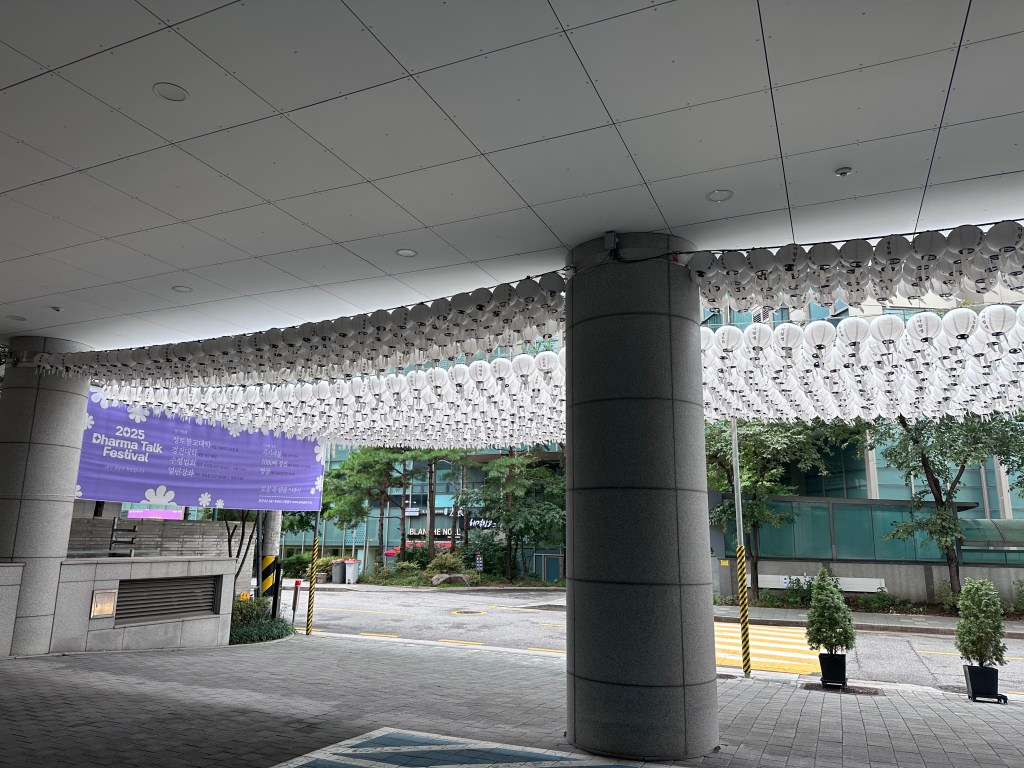
Yesterday, I visited a Buddhist center in Seocho-dong, Gangnam—part of the Jungto Society in Seoul, Korea.
They offer a free four-hour program called “Jeol-cation (절캉스)”, a kind of urban templestay for people looking to take a breath in the middle of city life.
I wasn’t sure what to expect, but the moment I arrived, I was surprised.
Unlike the traditional temples hidden deep in the mountains, this one was modern, sleek, and immaculately clean.
The volunteers welcomed me with warm smiles and quiet kindness, which instantly softened something inside me.
The highlight of the visit was the guided meditation session.
I’ve always struggled with meditation.
Whenever I closed my eyes, I’d wonder, “Am I doing this right? What should I be feeling? How do I know if I’m meditating correctly?”
But something the monk said finally made things click.
He explained that true meditation lies somewhere between two extremes:
① a state of total relaxation — and ② a state of intense, alert focus, like a soldier keeping watch.
He said if you’re too relaxed, you’ll get sleepy or lost in thought.
But if you focus too hard, your body tenses up and your senses become overly sharp.
The sweet spot is somewhere in the middle — relaxed, but alert.
That explanation helped me more than any book or app ever did.
I sat in half-lotus position, eyes closed, and focused on the sensation of breath passing through my nose.
The monk said:
“At this moment, the only thing that truly exists is your breath.”
He called that the core of meditation.
And when thoughts arise — and they will — it doesn’t mean you’re failing.
For example, if your thoughts are about future plans or to-dos, those thoughts often grow from worry.
If the thoughts are about past events, they often come from pain or unresolved emotions.
In my case, I kept thinking about what to cook for dinner, how to help my mom next week…
It was like a noisy traffic jam inside my head.
But the monk gently reminded us:
“That, too, is part of meditation.
Simply recognize the thought, watch it pass,
and gently return to the breath. That’s all.”
We did two sessions:
First, 10 minutes of seated meditation, followed by walking meditation.
Then another 30-minute seated session.
I had never sat still for that long before.
And during those 30 minutes, my legs hurt, I itched, I got distracted.
But somehow, I also got it.
Not perfectly.
But a little more than before. I used to think meditation was about emptying your mind.
Now, I think it’s more about watching your mind without judgment — breath by breath, moment by moment.

 The Healing Korean